Tuesday, May 7, 2024

Fading Naari Shakti: BJP's Decreasing Female Representation in UP Polls
The Congress party has declared 17 candidates for the state, but just one of them is a woman, suggesting that the party has abandoned the slogan "Mahila Hoon, Lad Sakti Hoon." 
Prime Minister Narendra Modi with female lawmakers after introducing the 'Nari Shakti Vandan Adhiniyam'
Prime Minister Modi poses with female lawmakers following the introduction of the 'Nari Shakti Vandan Adhiniyam'. (Photo: File)

New Delhi: In the latest Uttar Pradesh elections of 2024, the Bharatiya Janata Party (BJP) has fallen short of its pledge to enhance female representation in the Lok Sabha. Despite the enactment of a law by Prime Minister Narendra Modi's administration aimed at ensuring that 33% of directly elected members to Parliament and State Legislatures are women, the BJP has nominated fewer female candidates compared to the previous two elections in 2014 and 2019.

The Constitution (128th Amendment) Bill of 2023, dubbed the Nari Shakti Vandan Adhiniyam by Modi, was introduced with the intention of appealing to female voters. This legislation also reserves one-third of the seats within the 33% quota for women belonging to Scheduled Castes and Scheduled Tribes. However, the enforcement of this law depends on the publication of a new census and subsequent delimitation processes, leading to uncertainty about its implementation timeline, with some experts suggesting it may not be feasible until the 2029 Lok Sabha election or later.

Although political parties like the BJP have no legal obligation to increase female representation, they could have used this election to demonstrate their commitment to promoting women's participation in public affairs. Despite Modi's rallies celebrating Nari Shakti and the BJP's portrayal of the law as a significant step towards women's empowerment, the party's actions have not aligned with its rhetoric.

In Uttar Pradesh, the BJP has nominated fewer women candidates compared to previous elections. Out of 79 candidates announced by the BJP-led National Democratic Alliance (NDA), only eight are women. This marks a decline from the 11 women candidates fielded by the BJP alliance in both 2014 and 2019. Moreover, the BJP replaced several incumbent female MPs with male candidates for the 2024 elections, resulting in a net decrease in female representation.

Conversely, the party's main rival, the Samajwadi Party (SP), has nominated more women candidates, with 10 out of their total nominations. Including the Congress' sole female candidate, the count reaches 11 within the broader INDIA bloc. The Congress, which championed the 'Mahila Hoon, Lad Sakti Hoon' slogan during the 2022 UP Assembly elections with 40% female candidates, has significantly reduced its female representation. Out of 17 candidates declared by the party, only one is a woman.

Notably, many female candidates from both major blocs, NDA and INDIA, come from politically influential backgrounds or families, with several being spouses or daughters of current or former politicians.

In summary, despite the rhetoric surrounding women's empowerment, the representation of women in Uttar Pradesh's 2024 elections does not reflect the promised commitment to gender parity in politics.

Monday, May 6, 2024

 Contrasting Visions: Rahul Gandhi's Promises and Narendra Modi's Deflections

Rahul Gandhi addressing a rally in Khargaon, Madhya Pradesh, making promises to waive off farmers' loans and expand reservation policies.
Rahul Gandhi. Photo: X/@RahulGandhi

Rahul Gandhi, a prominent leader of the Indian National Congress, made noteworthy promises and accusations during a rally in Khargaon, Madhya Pradesh. He declared that if the Congress party is elected to power in the ongoing Lok Sabha elections, they will promptly waive off loans for farmers. Furthermore, Gandhi asserted that his party would eliminate the 50% cap on reservations, which are affirmative action measures aimed at providing opportunities to historically marginalized communities.

During his address, Rahul Gandhi accused the Bharatiya Janata Party (BJP) of intending to abolish reservations if they come to power. He claimed that BJP leaders have expressed their desire to dismantle the current reservation system, which benefits Scheduled Castes, Scheduled Tribes, and Other Backward Classes. In contrast, Gandhi promised that a Congress-led government would not only maintain existing reservations but also expand them beyond the current limit of 50%. He emphasized the importance of reservations in ensuring social justice and empowering disadvantaged sections of society.

Rahul Gandhi challenged Prime Minister Narendra Modi on key issues such as reservations, the Constitution, and welfare policies. He questioned Modi's stance on reservations for Adivasis (indigenous communities) and whether his government would increase the 50% cap on reservations. Gandhi framed these issues as central to the ongoing election, highlighting the Congress party's commitment to protecting the rights of the poor and marginalized.

In addition to addressing reservation policies, Gandhi outlined a series of welfare measures proposed by the Congress party. These include providing financial assistance of Rs 1 lakh to each family, offering Rs 1 lakh to youth for employment opportunities, waiving farmers' loans to alleviate agricultural distress, doubling the wages of ASHA and anganwadi workers, and increasing the minimum wage under the Mahatma Gandhi National Rural Employment Guarantee Act (MGNREGA) to Rs 400.

Meanwhile, Prime Minister Modi, campaigning in Nabarangpur, Odisha, sought to deflect attention from allegations of corruption surrounding his government. Modi claimed that the people of Odisha had rejected both the Congress and the ruling Biju Janata Dal (BJD) in favor of his Bharatiya Janata Party (BJP). He touted his government's efforts to combat corruption, citing the implementation of initiatives like the Jan Dhan Yojana, Aadhaar, and mobile connectivity to prevent the misappropriation of funds meant for the poor.

Modi's remarks come amidst scrutiny over the BJP's handling of electoral bonds, which have raised concerns about potential corruption within the party. Despite ongoing controversies, Modi reiterated his commitment to rooting out corruption and ensuring accountability within his administration.

In summary, Rahul Gandhi's speech in Khargaon underscored the Congress party's promises of economic relief for farmers, expansion of reservation policies, and overall welfare initiatives aimed at addressing social inequalities. In contrast, Narendra Modi sought to deflect criticism and emphasize his government's purported efforts to combat corruption and promote transparency. These contrasting narratives highlight the key themes and stakes involved in the ongoing electoral contest in India.

Wednesday, May 1, 2024

Religious Rhetoric at Lok Sabha 2024 Rally: Modi's Remarks Spark Debate
Prime Minister Narendra Modi's address at a Lok Sabha 2024 rally in Medak District, Telangana, has reignited debate as he once again invoked religion. Accusing the Congress of obstructing parliamentary proceedings and challenging electoral processes, Modi pledged to safeguard reservations for marginalized communities, promising not to allocate them based on religion. Meanwhile, the Congress manifesto emphasizes inclusive development and justice, without explicit reference to religious matters.

In his speech, Prime Minister Narendra Modi stirred controversy by once again bringing religion into the political discourse. His remarks at the Lok Sabha 2024 rally in Medak District, Telangana, have sparked a fresh wave of debate, with critics questioning the appropriateness of invoking religious sentiments in electoral campaigns.

During his address, Modi took aim at the Congress party, accusing them of hindering the functioning of Parliament and undermining the integrity of electoral processes. He criticized the Congress for allegedly questioning the Election Commission and Electronic Voting Machines (EVMs), painting them as obstacles to fair governance.

Furthermore, Modi reiterated his commitment to protecting reservations for marginalized communities, including Dalits, Scheduled Castes (SCs), Scheduled Tribes (STs), and Other Backward Classes (OBCs). He emphasized that these reservations should not be allocated based on religion, reaffirming his stance on maintaining the secular fabric of the nation.

On the other hand, the Congress manifesto for Lok Sabha 2024 adopts a different approach. It focuses on themes of inclusive development and justice, without making explicit references to religious matters. Instead, the manifesto pledges to lead the country towards a path of all-round progress, equality, freedom, and fairness for all citizens.

The contrasting narratives presented by Prime Minister Modi and the Congress highlight the divergent strategies employed by political parties in the lead-up to the elections. While Modi's speech appeals to certain voter demographics by invoking religious and identity-based sentiments, the Congress manifesto opts for a broader message centered around inclusive growth and social justice.

In summary, Prime Minister Narendra Modi's remarks at the Lok Sabha 2024 rally in Medak District, Telangana, have stirred controversy by reigniting debates surrounding religion and politics. His accusations against the Congress, coupled with his pledge to safeguard reservations, reflect the contentious nature of electoral campaigning in India. Meanwhile, the Congress manifesto emphasizes inclusive development and justice, signaling a different approach to addressing voter concerns.

Saturday, April 27, 2024

Firestorm Unleashed: Nadda Echoes Modi's Muslim Remarks as Thakur Alleges Foreign Interference


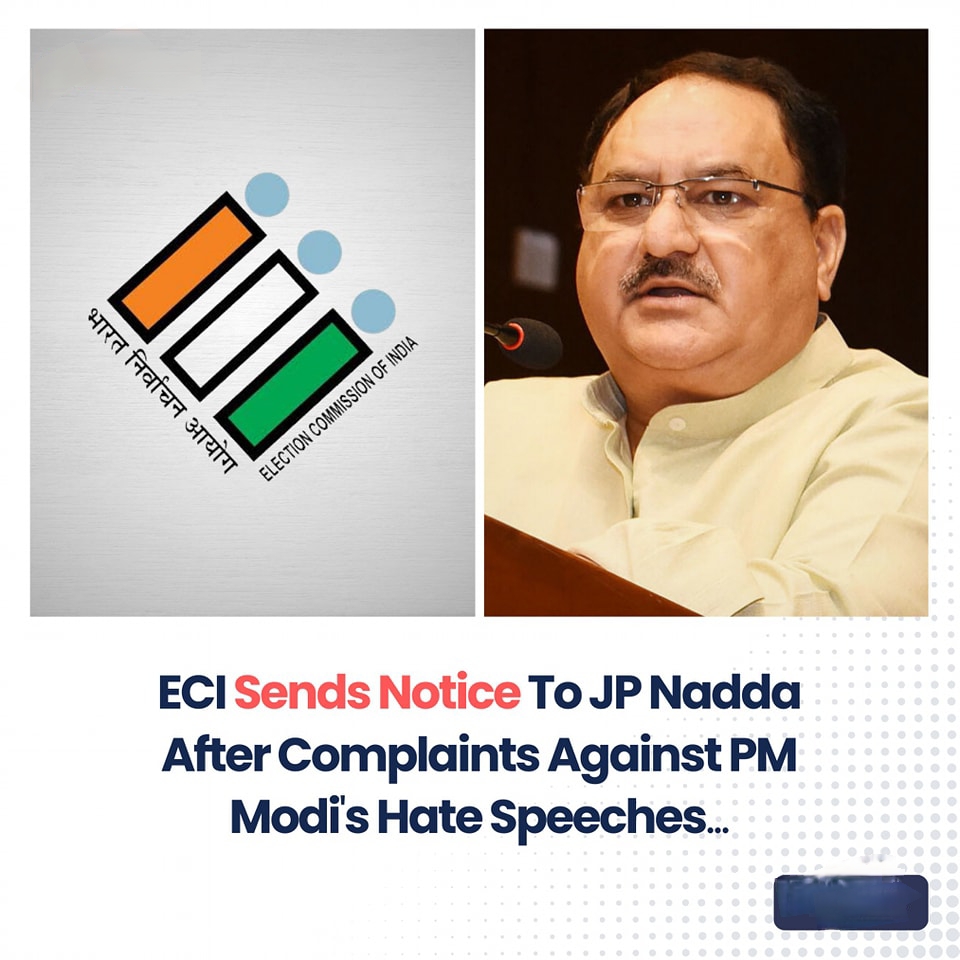
jp nadda
In the wake of the Election Commission of India's notice to JP Nadda for echoing Prime Minister Modi's comments on Muslims, Nadda restated the PM's stance, accusing the Congress of planning to transfer rights and properties from lower-caste groups (SC, ST, and OBC) to Muslims. Meanwhile, Union Minister Anurag Thakur joined the fray, suggesting foreign forces' involvement in the matter, alleging a scheme to allocate property to Muslims.

Friday, April 26, 2024

Election Commission Notice: Complaints Against Prime Minister Modi Circumvented?


Election commission

Is the Election Commission avoiding directly addressing complaints against Prime Minister Modi? Discover more in our new article.

In a notable development, the Election Commision of India has issued a notice for alleged violation of the Model Code of Conduct based on complaints against Prime Minister Modi. Surprisingly, the notice was directed to BJP President J.P. Nadda rather than directly to PM Modi, and notably, the Prime Minister's name is omitted from the notice entirely. Similarly,Congress Chief Mallikarjun Kharge received a similar notice regarding complaints involving both him and Rahul Gandhi.

Legal Battle in Assam: Village Challenges Election Coercion
What actions are residents of a Muslim-majority village in Assam's Karimganj parliamentary constituency taking against Assam forest department?
In Assam's Karimganj parliamentary constituency, residents of a Muslim-majority village have initiated legal proceedings against nine Assam forest department officials. The officials allegedly threatened villagers, coercing them to support the Bharatiya Janata Party candidate or face eviction with bulldozer assistance. 

Wednesday, April 24, 2024

Delhi University Students Condemn Election Commission: Calls for Action Against Hate Speech

Delhi University students gathered for a symbolic condolence meeting, highlighting their dissatisfaction with the Election Commission's performance. They specifically criticized the Commission's alleged neglect in addressing hate speeches attributed to Prime Minister Modi and his party members, expressing concerns about the integrity of the electoral process.


Bharatiya Janata Party Expels Usman Ghani Over Criticism of PM Modi's Comments on Muslims"
Does the expulsion of Usman Ghani from the Bharatiya Janata Party reflect favoritism towards Prime Minister Modi's stance on Muslims, or is it a standard protocol for handling dissent within the party?
The Bharatiya Janata Party has ousted Usman Ghani from his position as the president of its Bikaner District Minority Morcha. This action came after Ghani publicly denounced Prime Minister Narendra Modi's statements about Muslims being infiltrators. The party leadership accused Ghani of tarnishing the party's reputation in the media and has consequently barred him from party membership for a duration of six years.

Monday, April 22, 2024

Samajwadi Party and Congress Did Nothing To Advance Muslims: PM Modi in Uttar Pradesh

The Prime Minister claimed that these two parties had a history of engaging in politics of appeasement and that the BJP was responsible for protecting Muslim women's lives by enacting legislation prohibiting triple talaq.

Mr. Modi, critics argue that your rhetoric about the Congress and Samajwadi Party's alleged neglect of Pasmanda Muslims is a distraction from addressing broader socio-economic issues faced by marginalized communities. How do you respond to the perception that your focus on appeasement politics detracts from meaningful efforts to uplift all sections of society, regardless of political affiliations?

Aligarh (Uttar Pradesh): Prime Minister Narendra Modi on Monday said that Congress and Samajwadi Party always get worried whenever he tries to discuss the plight of Pasmanda Muslims as these parties have not done anything for the upliftment for the community. Prime Minister said that these two parties have always been involved in appeasement politics and that it was the BJP that secured the lives of Muslim women by bringing legislation against triple talaq. Addressing an election rally in Aligarh, Prime Minister Modi said, "Parties like Congress and SP have always done appeasement politics and have never done anything for the political, social and economic upliftment of Muslims. When I discuss the plight of Pasmanda Muslims, 'inke baal khade ho jate hai kyuki upar ke logon ne malai khai hai' and they have forced the Pasmanda Muslims to live in the same condition." "In this area, the lives of many daughters who were victims of triple talaq were ruined and not only the daughters, but due to triple talaq, the daughter, her father, brother and family all got troubled. Now Modi has also secured their lives by making a law against triple talaq," he added. Prime Minister also mentioned that he is receiving blessings from thousands of women after the government allowed women to travel to Haj without 'Mehram'. "Earlier, due to less Haj quota, there used to be a lot of fighting and bribery was also prevalent there and only the influential people would get the chance to go to Haj. I had requested the Crown Prince of Saudi Arabia to increase the Haj quota for our Muslim brothers and sisters in India. Today, not only has India's Haj quota increased but visa rules have also been made easier. The government took a very important decision. Earlier, our Muslim mothers and sisters could not go alone for Haj. The government also allowed women to go for Haj without 'Mehram' and I am being blessed by thousands of sisters whose dream of going for Haj has been fulfilled," he said. Praising Uttar Pradesh Chief Minister Yogi Adityanath, Prime Minister Modi said that the state is soon going to become a big hub of self-reliant India."Because of BJP, now our UP is going to become a big hub of Atmanirbhar Bharat. I want to open the eyes of those people who keep identifying Yogi ji only with bulldozers. Whatever industrial development has happened in Uttar Pradesh after independence, it happened during the period of Yogi ji alone," PM said. "His mission of One District, One Product is creating new respect in the entire country. You talked about bulldozers, if someone has taken the development to new heights, Yogi ji's government has taken it and as an MP from Kashi, he is also my Chief Minister. I feel proud that I have such colleagues," he added. Aligarh Lok Sabha seat will go to polls in the second phase on April 26 along with Gautam Buddha Nagar, Meerut, Baghpat, Ghaziabad, Aligarh, Mathura and Bulandshahr seats in Uttar Pradesh.